
Wayne Parole and Probation Compared
A person can live in Wayne County after release yet fall under one of several forms of supervision. Parole is conditional release from an eligible prison sentence by the Ohio Parole Board, followed by supervision through the Ohio Department of Rehabilitation and Correction Adult Parole Authority. Post-release control is also an APA function after prison, although its source and duration depend on the sentence. Probation is the common term for court supervision. Ohio court records often call felony probation community control. It comes from the sentencing court rather than from a parole decision.
The distinction affects where to verify a record. ODRC's offender system can show a former state prisoner as “APA Supervision.” A Wayne County Common Pleas docket can show a felony community-control order, later changes, violation proceedings, and termination. Wayne County Municipal Court handles misdemeanor probation. None of those labels, by itself, means the person remains in a jail or prison. They describe legal duties after a custody exit.
| Supervision type | Source | Best public check |
|---|---|---|
| Parole | Ohio Parole Board decision after an eligible prison term | ODRC status, release/parole detail, hearing record, and APA office |
| Post-release control | State-prison sentence and Ohio law | ODRC detail showing APA supervision dates and office |
| Felony community control | Wayne County Court of Common Pleas | Sentencing entry, later docket events, and Common Pleas Adult Probation |
| Misdemeanor probation | Wayne County Municipal Court | Municipal docket and Municipal Adult Probation |
| Discharge | Supervising authority or court | Termination, expiration, or discharge entry from that authority |
Verify Wayne Post-Release Supervision
Begin with the court and custody class tied to the release. A Wayne County Jail exit alone does not identify parole or probation. The person could have posted bond, completed a short jail term, transferred to ODRC, or left under a court order. The Wayne County released-inmate search path helps establish that custody event. Supervision verification then follows the authority named in the sentence or state record.
- Match the person to the Wayne County case by case number, name, and available dates. Read the sentencing journal entry rather than relying on a charge summary.
- If the person entered Ohio prison, open the ODRC Offender Search. Search by offender number when known, or use the name and Wayne as County of Commitment.
- Run the ODRC status filter for APA Supervision. Open the detail and compare birth date, offender number, offense, Wayne docket, residential county, supervision dates, and APA office.
- For a Common Pleas sentence, inspect later docket entries for community control, modification, violation, termination, or discharge. Contact Common Pleas Adult Probation when the public docket is unclear.
- For a misdemeanor case, use the Municipal Court docket and Municipal Adult Probation. Do not route that case to ODRC unless a separate state-prison record exists.
- Save the exact status wording and access date. Dynamic supervision records can change after a violation, court order, transfer, expiration, or correction.
This order prevents a common mistake. County of Commitment links an Ohio prison record to Wayne County, while Residential County is the last address recorded for a person under APA supervision. It is not a live location. ODRC also warns that a displayed supervision period may arise from an earlier offense and may not align with the offense currently shown. Match the whole detail before treating the dates as one case.
Note: An original supervision sentence does not prove current supervision because later entries may modify, toll, terminate, or discharge it.
Wayne Parole and Probation Offices
Wayne County has three supervision routes, not one all-purpose parole office. For parole or post-release control, use the APA office named on the ODRC detail and confirm the route through the ODRC Field Services directory. For felony community control, the local source is Common Pleas Adult Probation. Municipal Adult Probation handles the local misdemeanor layer. Calling the office tied to the actual order is faster and more accurate than asking a different agency to interpret it.
Common Pleas Adult Probation
Office management: 330-287-5550
Re-entry Court / ISP: Chief Courtney Burnett, 330-287-5554
Re-entry Court: Brandi Couch, 330-287-5556
Wayne County Common Pleas Adult Probation
Municipal Adult Probation
215 N. Grant Street
Wooster, OH 44691
330-287-5650
Monday through Friday, 7:30 a.m. to 4:30 p.m.
Wayne Municipal Adult Probation
The official APA field-services page shows the state route used to locate an assigned supervision office.
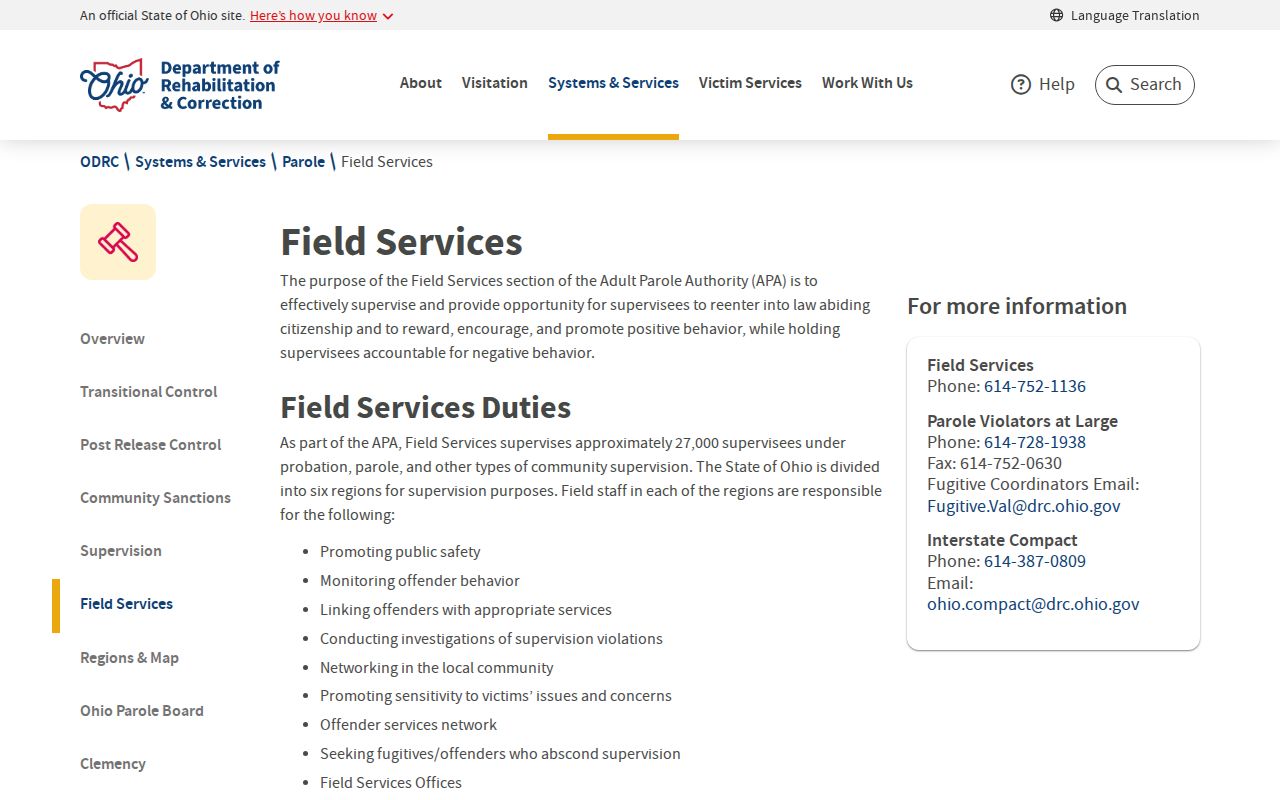
The office shown on the matched offender detail remains the best contact because APA assignment is based on the state record, not on a guessed local address.
Wayne Supervision Violations and Status
Supervision conditions are duties imposed by the court, Parole Board, or APA. Public material may refer to reporting, treatment, monitoring, or other terms, but the controlling order and supervising office define the person's actual conditions. A missed report or filed violation does not let a reader infer the result. The court may modify supervision, continue it, issue an order, or take another action. State parole matters follow the APA and Parole Board process.
ODRC supplies a specific status called “Violators at Large.” The Department says it has no current known location for a person in that status and displays only the last recorded address before the at-large classification. That label should be quoted as written. It does not prove current incarceration. It also does not justify stating that a warrant exists unless an official court or agency record actually shows one. The ODRC Violators at Large list is a state source, while a Wayne County docket supplies local court action.
VINE can provide a custody-change alert for a participating record, but it is not a supervision case file. A transfer, return to custody, parole revocation event, or release from parole has its own meaning. Quote the alert and confirm it with the agency that owns the event.
Wayne Reentry Court After Release
Wayne County's reentry landscape is tied to its courts. Common Pleas Adult Probation identifies Re-entry Court officers and individualized referrals. Those referrals may address substance-use or behavioral-health services, support programs, and educational help. The county's Intensive Supervision Program describes day reporting, electronic monitoring, counseling or treatment, and case management as intermediate sanctions. These are local supervision tools, not proof that every released person qualifies or takes part.
The Wayne County Community Corrections Board publishes planning and meeting material for the local corrections system. It helps explain policy and program structure. It is not an individual lookup, and its program descriptions should not be read as a current supervision record. To verify one person, return to the exact Common Pleas case and the identified probation office.
This local split matters after a Wayne County release. A person in Re-entry Court or the Intensive Supervision Program can be outside jail while still subject to a Common Pleas order. Another Wayne resident may instead report to APA after leaving an ODRC institution. A third may have Municipal probation. The agency name in the record decides which path applies.
Note: Wayne County program pages describe available structures, but only the case record and assigned office establish an individual's participation.
Wayne Supervision Record Terms
Ohio and Wayne County sources use terms that mark different legal stages. Keeping them separate prevents a post-release status from being mistaken for incarceration or final freedom from all sentence duties.
- Parole
- Conditional release from an eligible prison sentence, decided through the Ohio Parole Board and supervised by APA.
- Probation or community control
- Court-ordered supervision in the community. In Wayne felony cases, the docket often uses “community control.”
- Post-release control
- An Ohio supervision period that follows certain prison terms and is administered through APA.
- Absconder
- A person alleged to have stopped reporting or left supervision. Use only the official status or filing supplied by the authority.
- Discharge
- The formal end of a sentence or supervision obligation, as shown by the responsible court or agency.
“Released” answers a custody question. “Discharged” may answer a broader sentence question. Someone can be released from prison to APA Supervision, then discharged later. A Wayne County jail release can also begin or continue Common Pleas or Municipal supervision. Dates should be labeled by event so that release, supervision start, expiration, and final discharge do not merge into one claim.
When Wayne Supervision Ends
Final verification comes from the authority that supervised the person. For Wayne County felony community control, inspect the Common Pleas docket for termination or discharge after the sentencing entry and any later modification or violation. For misdemeanor probation, use the Municipal docket and its probation office. For state parole or post-release control, read ODRC's status, supervision dates, and release/parole detail, then ask the named APA office about any ambiguity.
A projected expiration date is not always the same as an accomplished discharge. Tolling, a return for violation, a new order, or a data correction can affect what appears later. ODRC records also have access limits. Ohio law does not open every APA case-management note to the public, even though selected Offender Search items such as name, conviction, photograph, supervision status, and place of incarceration may be displayed. Request only the specific public fact needed and let the agency identify any restriction.
Save the exact entry, source, and access date. If the court docket, ODRC detail, and office response disagree, the most recent record from the authority that owns the event deserves follow-up. That method distinguishes an actual Wayne County discharge from a date that was merely expected.